
The following excerpt is from the Homily given by Father Perry Henry, Director of the Daughters of Charity, Province of St. Louise, USA on the occasion of their Provincial Assembly. His call to be Artisans of Peace can move the heart of all of us.
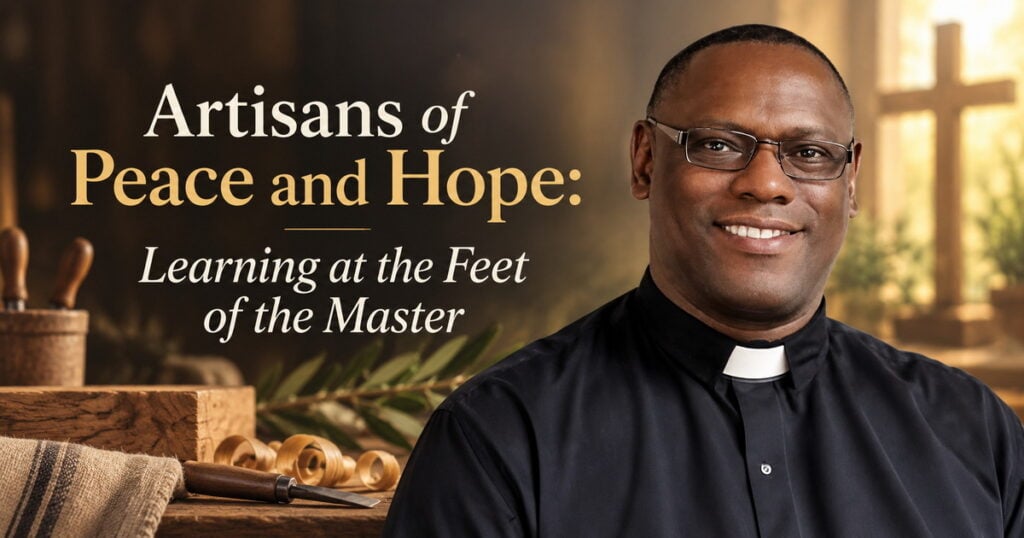
The Artisan’s Spiritual Wisdom
An artisan works with attentiveness rather than urgency, with respect rather than domination. She knows the material she touches—the way clay resists, the way thread tangles, the way wood bears its own inner grain. Nothing lasting is achieved without patience.
Spiritually, this mirrors our own formation. God shapes us over time. Interior life deepens slowly. Communion grows through forgiveness repeated again and again. Mission bears fruit through faithfulness, often hidden and uncelebrated. The artisan reminds us that transformation cannot be rushed and that grace works gently, even through resistance.
The artisan also teaches us cooperation. She does not force the material; she listens to it. This offers a powerful image for our relationship with God. We are not called to control our spiritual growth, our ministries, or even the future of the Company. We are called to cooperate with grace—to respond, to remain available, and to trust the process God is unfolding.
In artisan work, imperfection is not failure. Each piece bears marks of limitation and uniqueness. These marks do not detract; they humanize. For us, this becomes a call to compassion—toward ourselves, toward one another, and toward the world we serve.
Peace begins when we accept that brokenness and beauty coexist, in us and in others.
Artisans of Peace in a Troubled World
To be an artisan of peace is not to avoid conflict, but to engage it differently. It means choosing dialogue over judgment, presence over polarity, mercy over indifference. It means weaving peace patiently in communities, ministries, and relationships where tensions are real and fatigue is present.
Peace begins in interiority. Without silence, prayer, and rootedness in Christ, our actions risk becoming reactive rather than prophetic. The artisan does not work in chaos; she works with focus. Likewise, our mission depends on an interior life that continually returns to the Source.
Artisans of Hope
To make something carefully in a culture of disposability is already an act of hope. Artisan work declares that what is made—and who is made—is worth time, care, and repair. In this sense, hope is not passive waiting; it is active fidelity.
Our hope rests in God, but it is made visible through our choices: to accompany rather than abandon, to form rather than replace, to believe in possibility where others see only limitation. Hope is woven through small daily acts—faithful service, communal prayer, attentive listening, and perseverance when outcomes remain uncertain.
Entering the Workshop of the Master Artisan
Jesus, the Master Artisan, invites us into His workshop, as He says, “Come to me, all you who labor and are burdened, and I will give you rest.”
In the dusty streets of Nazareth, Jesus learned the trade of a tekton—the Greek term for a carpenter, builder, or craftsman. He understood the resistance of wood, the weight of stone, and the patience required to create something beautiful and enduring. But His greatest work was never furniture or buildings. His greatest work is the transformation of the human heart.
Each of us enters His workshop carrying unfinished edges. We carry personal weaknesses, communal challenges, wounds from ministry, disappointments, and perhaps even fears about the future. Sometimes we may feel more like rough timber than finished masterpieces.
Yet the Master Artisan never rejects imperfect materials. He sees not simply what we are, but what we can become through grace.
He takes the wood of our humanity and patiently shapes it. He sands down the rough edges of pride. He strengthens weakened places through His mercy. He joins together what has become fractured. He brings beauty out of what seems broken.
That is why our priority calls us to begin by learning at His feet.
Learning at His Feet
In the Gospel account of Mary and Martha, Mary becomes the icon of every disciple. While Martha was occupied with many concerns, Mary sat at the feet of Jesus and listened to Him. This posture—learning at His feet—is not passive. It is transformative.
To sit at the feet of the Master means first to adopt the posture of a student. In the ancient world, disciples sat at the feet of their rabbi to learn not only his teachings but also his way of life. Our mission is not merely to do the works of Jesus, but to learn the heart of Jesus.
Second, it means embracing the posture of rest. The needs around us are endless. Poverty is complex. Violence and division fill our world. Yet Jesus reminds us that peace cannot be given unless peace is first received.
As artisans of peace and hope, you do not manufacture peace through your own efforts. You receive it from Christ and then bring it to others.
Third, sitting at His feet requires the posture of humility. It means surrendering our own plans and blueprints. It means allowing the Lord to redirect us, surprise us, and lead us into places we would never have chosen for ourselves.
Returning to the Source
Our source is not a program. It is not an initiative. It is not even our venerable traditions by themselves. Our source is Jesus Christ.
Saint Vincent knew this. Saint Louise knew this. They continually returned to Christ, discovering in Him new pathways for charity and mission.
And perhaps that is exactly what the Spirit is asking of us today.
Going Deeper in a Changing World
Our world has changed dramatically since the time of Vincent and Louise. The forms of poverty are evolving. Loneliness, migration, violence, polarization, mental illness, and spiritual hunger confront us in new ways. The answer is not simply to work harder. The answer is to go deeper.
Only hearts anchored in Christ can recognize the new movements of the Spirit. Only disciples sitting at the feet of the Teacher can hear where the Teacher is sending us next.